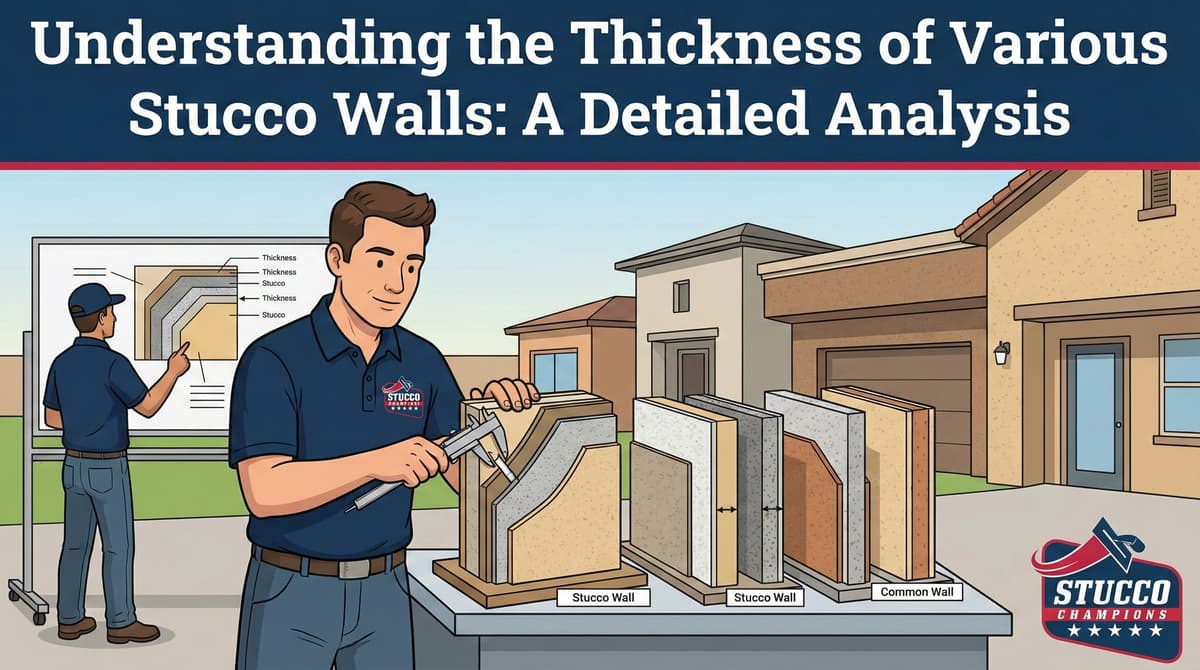
Understanding the Thickness of Stucco Walls: A Detailed Analysis
The Official Guide to Stucco Thickness: ASTM C926 Standards Explained
In the world of construction, "thickness" is not a suggestion—it is a code requirement. One of the most common causes of stucco failure (cracking, delamination, and water intrusion) is the failure to apply the correct amount of material.
If the stucco is too thin, it lacks structural integrity and fire resistance. If it is too thick (especially overhead), it risks sagging and bond failure.
The industry standard is defined by ASTM C926 (Standard Specification for Application of Portland Cement-Based Plaster). The following guide breaks down Table 6 of this code, ensuring your project meets the legal and structural benchmarks.
1. Wood Frame Construction (Vertical Walls)
The Standard Residential System
When applying stucco over open wood framing or sheathing (using metal lath), you are creating a rigid slab that must withstand the movement of the wood studs. Therefore, this application requires the maximum thickness.
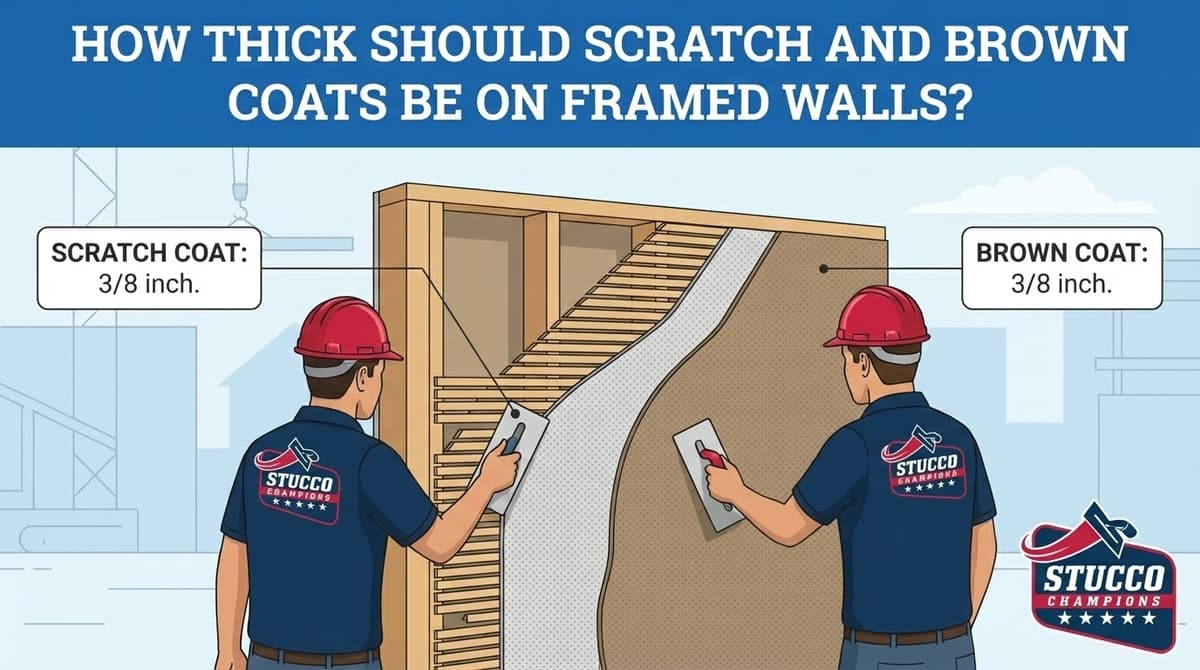
System Requirement: Three-Coat Work Total Thickness: 7/8 inch (22mm)-
1st Coat (Scratch): 3/8 inch (9.5mm).
-
Purpose: This coat must be thick enough to fully embed the metal lath. If the wire is exposed, it will rust.
-
-
2nd Coat (Brown): 3/8 inch (9.5mm).
-
Purpose: This is the leveling coat. It provides the flat surface and the bulk of the fire rating.
-
-
3rd Coat (Finish): 1/8 inch (3mm).
-
Purpose: The aesthetic texture.
-
Free Assessment
Noticing Stucco Damage?
Get a free on-site assessment from a licensed contractor. $0 deposit, no obligation.
GET FREE ASSESSMENT2. Unit Masonry (Brick & Block)
Vertical Walls
When applying over solid masonry (CMU blocks or brick), the wall itself provides the rigidity. Consequently, the stucco "cladding" does not need to be as thick as it does over wood. You have two options under the code:
Option A: Three-Coat Masonry
-
1st Coat: 1/4 inch
-
2nd Coat: 1/4 inch
-
3rd Coat: 1/8 inch
-
Total: 5/8 inch (16mm)
Option B: Two-Coat Masonry (The Efficiency Standard)
Code allows for a "Two-Coat" application on solid masonry, where the base coats are combined or simplified.
-
1st Coat (Base): 3/8 inch
-
2nd Coat (Finish): 1/8 inch
-
Total: 1/2 inch (12.5mm)
3. Solid Concrete (Cast-in-Place)
Vertical Walls
Poured concrete is smoother, harder, and less porous than block. A heavy layer of stucco can struggle to bond to it. Therefore, the code mandates a thinner application to ensure it stays attached.
-
Three-Coat Concrete: 5/8 inch Total.
-
Two-Coat Concrete: 3/8 inch Total (1/4" Base + 1/8" Finish).
4. Ceilings & Soffits (Horizontal Applications)
The "Gravity" Factor
Plastering overhead is the most dangerous part of the job. If you apply a standard "wall thickness" (7/8") to a ceiling, you are hanging approximately 10–12 lbs of wet cement per square foot over your head. The risk of the stucco detaching under its own weight is high.
To combat gravity, ASTM C926 mandates significantly thinner applications for horizontal surfaces.
A. Metal Lath Ceilings (Framed Soffits)
Even though this uses metal lath (like a wall), you cannot use the 7/8" wall standard.
-
1st Coat (Scratch): 1/4 inch (Reduced from 3/8")
-
2nd Coat (Brown): 1/4 inch (Reduced from 3/8")
-
3rd Coat (Finish): 1/8 inch
-
Total Thickness: 5/8 inch (16mm)
B. Solid Masonry/Concrete Ceilings
The code is extremely restrictive here. The table explicitly states to "Use Two-Coat Work."
-
Maximum Thickness: 3/8 inch (9.5mm).
-
Why? The mechanical bond between plaster and smooth concrete overhead is the weakest link. Keeping the material thin (lightweight) is the only way to ensure safety.
Summary Reference Table
| Surface / Substrate | System | 1st Coat | 2nd Coat | 3rd Coat | TOTAL |
| Wood Frame (Metal Lath) | 3-Coat | 3/8" | 3/8" | 1/8" | 7/8" |
| Unit Masonry (Vertical) | 2-Coat | 3/8" | 1/8" | — | 1/2" |
| Unit Masonry (Vertical) | 3-Coat | 1/4" | 1/4" | 1/8" | 5/8" |
| Solid Concrete (Vertical) | 2-Coat | 1/4" | 1/8" | — | 3/8" |
| Ceilings (Metal Lath) | 3-Coat | 1/4" | 1/4" | 1/8" | 5/8" |
| Ceilings (Concrete) | 2-Coat | 1/4" | 1/8" | — | 3/8" |
Conclusion
Thickness isn't just about covering the lath; it's about physics.
-
Vertical Walls need thickness for impact resistance and fire ratings.
-
Horizontal Ceilings need thinness to reduce weight and prevent sagging.
Always measure your screeds and ensure your crew knows the difference between a wall mix and a ceiling mix. Following ASTM C926 is your best defense against cracking and liability.
Last week, we shared Understanding Stucco Color Coats: Options, Application, and Considerations, offering a comprehensive look at the choices and techniques for achieving the perfect stucco finish. If you’re planning to update your stucco, be sure to check out this detailed guide for expert insights!—