New Construction Stucco: A Long-Term Color Solution
Written by Stucco Champions — Southern California’s Authority on Exterior Plastering.
When building a custom home in Southern California, the exterior skin is more than just a visual choice; it is the first line of defense against our intense UV radiation and seismic activity. Stucco remains the gold standard for new construction because it offers a unique advantage that paint cannot match: Integral Color.
Unlike remodeling projects where we must bond to old surfaces, new construction provides a "clean slate." This allows us to engineer the entire building envelope—from the sheathing to the final color coat—without compromise. This guide explains why new construction stucco is the ultimate low-maintenance investment.
1. The Clean Slate Advantage
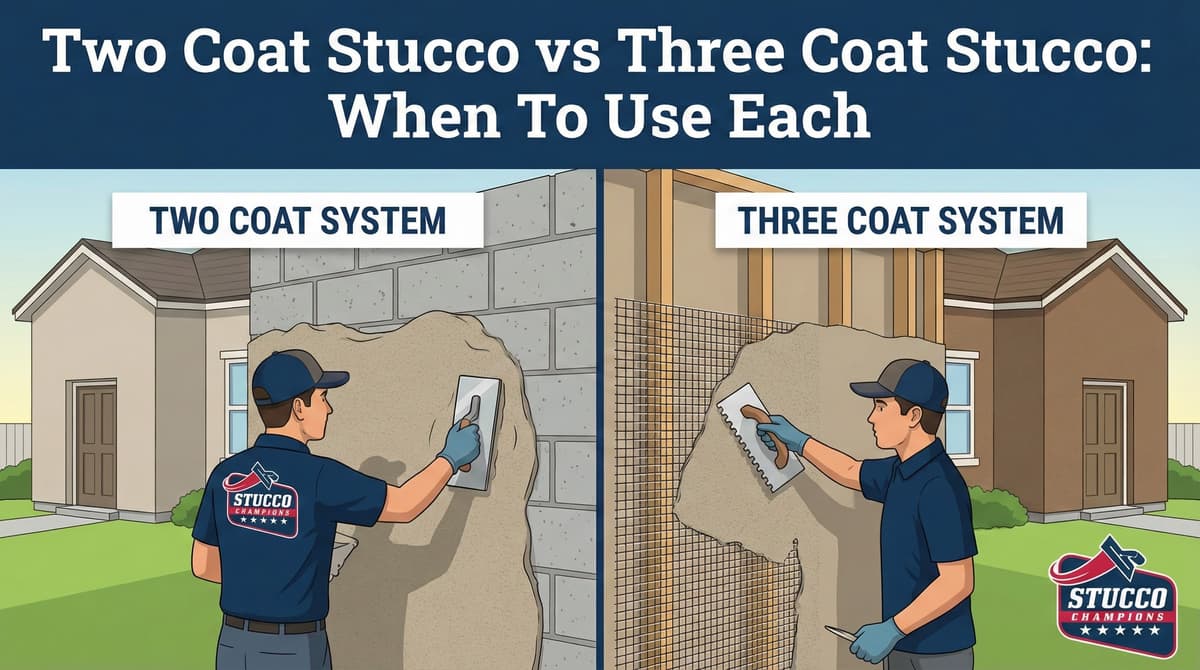
New construction allows for the perfect implementation of the Three-Coat System. There are no old layers of paint to sandblast, no cracks to patch, and no mismatched textures to blend.
The Integration: We install the weep screeds, window flashings, and Grade D paper in a continuous, shingled drainage plane. This eliminates the leak points common in retrofits and ensures the wall functions as a monolithic unit.
Free Assessment
Noticing Stucco Damage?
Get a free on-site assessment from a licensed contractor. $0 deposit, no obligation.
GET FREE ASSESSMENT2. Integral Color: The Science of Pigment
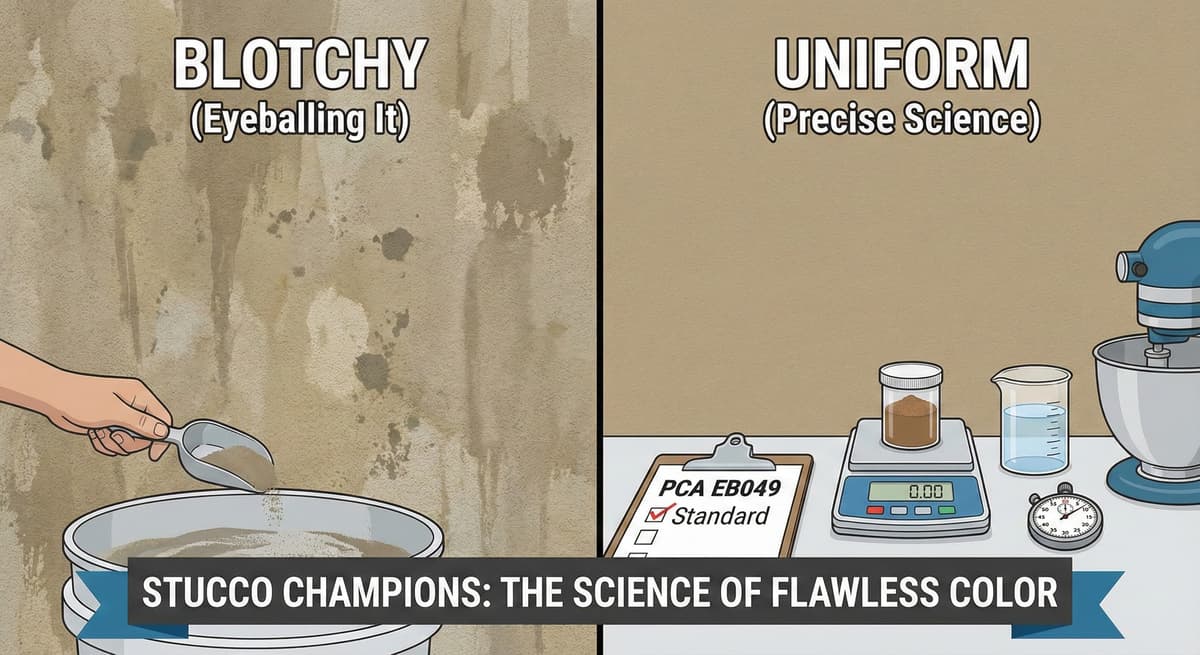
The primary benefit of new stucco is "Color Integration." We mix iron oxide pigments directly into the finish coat cement. The color isn't on the wall; the color is the wall.
| Feature | Painted Stucco | Integral Color Stucco |
|---|---|---|
| Durability | Surface film; can peel or blister. | Solid matrix; cannot peel. |
| Impact | Chips reveal grey cement underneath. | Chips reveal more of the same color. |
| Maintenance | Repaint every 5-7 years. | No repainting; wash annually. |
| Breathability | Often seals pores (traps moisture). | Highly permeable (lets wall breathe). |
3. Code Compliance: Building to ASTM Standards
In new construction, we adhere strictly to national standards to ensure the system is watertight and structural:
- ASTM C926: Governs the application of Portland cement plaster. We ensure the total thickness is a nominal 7/8 inch (for 3-coat) to provide the required ASTM E119 1-hour fire rating. We enforce a 48-hour moist cure for base coats and a 7 to 14 day total curing/drying window before applying the finish color coat.
- ASTM C1063: Governs the lathing. We ensure fasteners penetrate the studs and that control joints are placed to minimize cracking. We also verify weep screed clearances: at least 4 inches above raw earth and 2 inches above paved concrete.
- Title 24: For energy efficiency, we can integrate continuous foam insulation (One-Coat System) per ASTM C1397 / ASTM C1860 to reduce thermal bridging.
- CRC Section R703.7.3: Requires two layers of Grade D paper (or ASTM D226 asphalt-saturated felt / ASTM E2556 wrap) over wood sheathing to act as the primary WRB cleavage plane.
4. Customization: Texture and Tone
With new construction, you are not limited to matching an existing texture. You can choose:
- Santa Barbara Smooth: A sleek, modern finish that resembles adobe.
- Sand Finish: A uniform, gritty texture ideal for contemporary homes.
- Spanish Lace: A heavy, traditional texture perfect for hiding future imperfections.
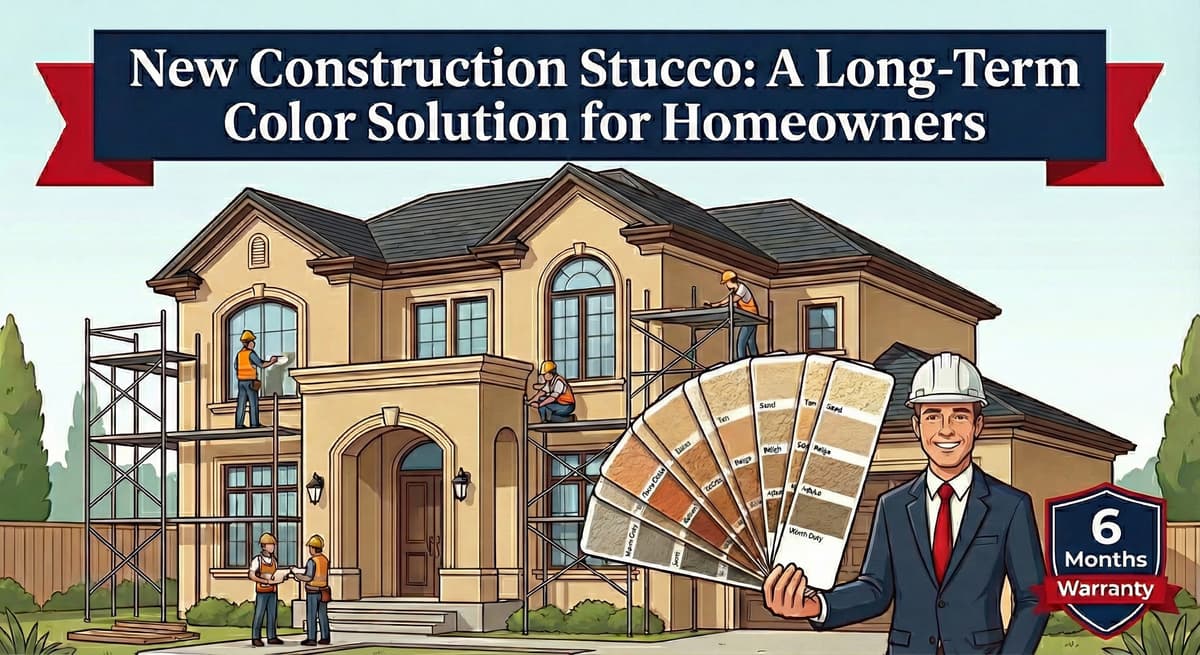
Never choose color from a paper chart. Stucco absorbs light differently depending on the texture. Before we apply the finish to your new home, we create a 2'x2' physical mock-up on the wall. We let it cure for 24 hours so you can see the true dry color in natural sunlight.
5. FAQ: New Construction Stucco
Q: How long does integral color last?
A: Indefinitely. While it will fade slightly over 15-20 years due to UV exposure, it does so evenly and naturally, unlike paint which fails in patches.
Q: Can I paint it later?
A: Yes. If you decide to change the color in 15 years, stucco accepts high-quality masonry paint perfectly. However, once painted, it becomes a painted wall forever.
Conclusion: The Lifetime Finish
Choosing integral color stucco for your new build is a decision for longevity. It reduces long-term maintenance costs and provides a depth of character that paint cannot replicate. At Stucco Champions, we treat your new home’s exterior as a permanent architectural feature, not just a surface to be covered.
Related Resources
Last week, we shared Navigating the World of Colored Stucco. If you are deciding between Earth Tones and Acrylics, read this comparison.
Frequently Asked Questions About Stucco
How much does stucco repair cost in Orange County and Los Angeles?+
Stucco repair typically ranges from $500 for minor crack patching to $5,000+ for full re-stucco of a single elevation. The exact cost depends on the damage type (hairline cracks, water damage, delamination, weep screed failure), the square footage involved, and whether the original three-coat or one-coat stucco system needs to be matched. Stucco Champions provides fixed-price written estimates after a free on-site assessment — no hourly billing, no surprise change orders. See our stucco repair cost guide for detailed pricing by repair type.
How long does stucco last in Southern California?+
Properly installed three-coat stucco lasts 50-80+ years in Southern California's climate. The most common failure points aren't the stucco itself — they're the supporting components: corroded weep screed, deteriorated building paper behind the stucco, and improperly sealed window flashing. Most "stucco failures" are actually moisture-intrusion failures that start at one of these points. Annual visual inspection catches problems before they spread, which is why we offer free weep screed assessments for homeowners in our service area.
Can I repair stucco myself, or do I need a contractor?+
Hairline cracks under 1/8 inch wide can be sealed with elastomeric caulk by a homeowner. Anything larger — pattern cracks, delamination (where stucco pulls away from the wall), water-damaged areas, or chimney/window leak repairs — requires a licensed contractor. Improper DIY repair on these is the #1 cause of repeat failures because the underlying cause (usually moisture) isn't addressed. California's CSLB requires a license for any stucco work over $500. Looking for a highly-rated stucco contractor in Southern California? We are a CSLB-licensed and insured team ready to help.
How do I know if I need stucco repair vs. full re-stucco?+
If less than 30% of an elevation has visible damage, repair is the right call. If you see large areas of cracking, multiple zones of delamination, or the underlying paper and lath have rotted across an entire wall, full re-stucco of that elevation is more cost-effective long-term. Our free assessment includes a moisture survey and lath inspection so you get a defensible recommendation either way — not just a quote pushing whichever option costs more.
Do you offer warranties on stucco work?+
Yes. Stucco Champions provides a written 5-year workmanship warranty on all stucco repairs and a 10-year warranty on full re-stucco. We're a CSLB-licensed and insured contractor (license #1122006 — verifiable at cslb.ca.gov), which means our work is backed by California's contractor licensing board, not just our own promise. Request a free estimate to see the warranty terms in writing before you sign anything.
How long does a stucco repair take?+
Most patch repairs are completed in 1-2 days, including a 24-hour cure time before texture matching and color application. Full re-stucco of a single elevation runs 5-7 working days because each coat (scratch, brown, finish) needs to cure properly before the next is applied. We schedule around weather — California stucco needs daytime temperatures above 50°F with no rain forecast for at least 24 hours after each coat. Our crew shows up on time, every time.