

Written by Stucco Champions — Southern California’s Authority on Exterior Plastering.
How Thick Should Scratch and Brown Coats Be on Framed Walls?
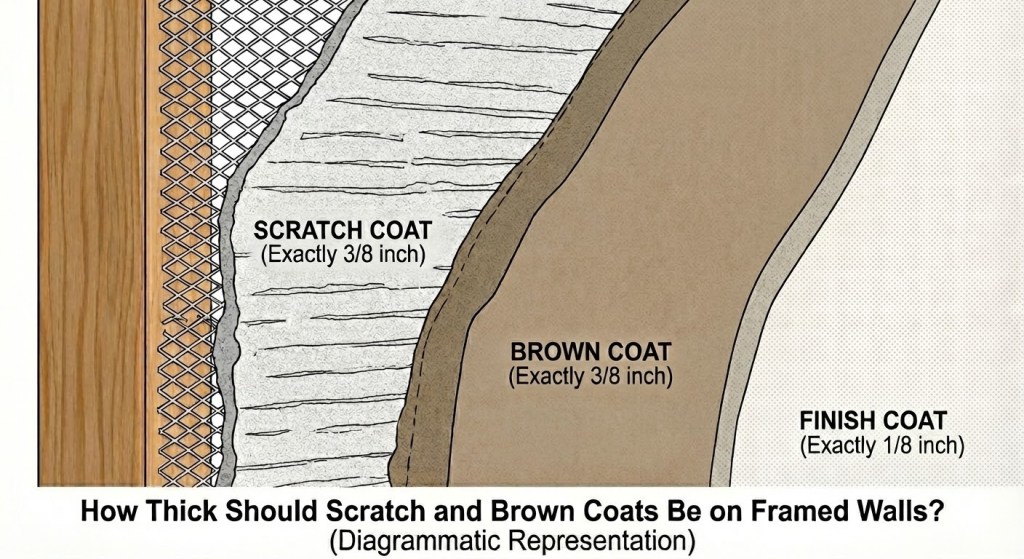
In a traditional three-coat stucco system, the scratch coat and brown coat are the structural backbone of your exterior. When applied to wood or metal framed walls, the scratch coat should be 3/8 inch thick, and the brown coat should also be 3/8 inch thick. These two base coats create a solid foundation before the finish coat is applied.
The total thickness for a three-coat stucco system on a vertical metal plaster base is a nominal 7/8 inch once the 1/8 inch finish coat is added. Maintaining this specific depth ensures each layer cures properly and bonds securely to provide the structural support that stucco systems require.
1. Why Thickness Matters for Base Coats
Each layer in a traditional stucco system has a specific job. The scratch coat bonds to the metal lath and creates the first layer of strength. It must completely encase the metal reinforcement to protect it against corrosion. The brown coat builds on that foundation and creates a flat and even surface for the finish.
If either coat is too thin, the system loses structural integrity and becomes prone to cracking. Most building codes in Los Angeles County and Orange County reference ASTM C926, which sets these standard thicknesses. Inspectors often measure total base coat thickness during rough inspections to ensure compliance.
This is the kind of precision a qualified stucco contractor monitors on every job. A pro team typically saves hours of back and forth and rework. If you want a free booking, you can click here.
2. How to Apply the Scratch Coat
The scratch coat goes directly over the weather resistive barrier and metal lath. Installers trowel the mortar onto the lath at 3/8 inch thick. They press firmly to fill all the openings in the mesh and ensure the lath is fully embedded.
Once the coat is applied and begins to firm up, workers score horizontal grooves into the surface. [Image of stucco wall layers cross section] These grooves act as water dams to aid curing and create a mechanical grip for the brown coat. The scratch coat generally needs to be moist cured. The brown coat is applied as soon as the scratch coat is sufficiently rigid to resist cracking.
3. How to Apply the Brown Coat
The brown coat is also applied at 3/8 inch thick. Installers spread the mortar over the scratch coat and use a straightedge or rod to level the surface.
The brown coat is not scored like the first layer. Instead, it is floated with a wood float to densify the plaster and create an even plane for the finish coat. Floating occurs only after the surface sheen has disappeared to ensure proper consolidation. The brown coat typically cures for seven days before the finish coat is applied.
4. Common Mistakes with Base Coat Thickness
Going too thin is the most frequent error. Coats under 3/8 inch may pass a quick visual check but they often fail to provide enough mass to resist cracking. Thin coats also tend to dry too quickly which results in a weaker bond.
Inconsistent thickness across the wall creates high spots and low spots. These variations will show through the finish. Professional applicators use screeds and check their work constantly to keep the plaster uniform.
Stucco Layer Specifications
| Coat | Thickness | Curing Note | Purpose |
|---|---|---|---|
| Scratch | 3/8 inch | Moist cure | Bonds to lath and scored for grip |
| Brown | 3/8 inch | 7 days typically | Levels surface and floated for density |
| Finish | 1/8 inch | Base coat moisture | Provides color and texture |
Note: Total nominal thickness for three-coat work on metal plaster base is 7/8 inch.
5. What Affects Base Coat Thickness
Lath Installation: Metal reinforcement must be furred out 1/4 inch from the framing. This space allows the scratch coat to slump behind the lath and embed it completely. If the lath is too tight to the wall, the plaster thickness may be compromised.
Wall Substrate: Framed walls with metal or wood studs require the standard three coat system with a 7/8 inch total thickness. Solid masonry walls may allow for a two coat system with different thickness requirements, but framed walls need the full depth for stability.
Temperature and Humidity: Weather affects how the mortar sets. In hot and dry conditions, the coats may need frequent misting to prevent rapid water loss. In cold weather below 40 degrees Fahrenheit, heated enclosures are necessary to prevent the plaster from freezing before it cures.
Trust Signals You Should Expect
Any contractor applying scratch and brown coats should be licensed and insured. Stucco Champions carries full coverage and never asks for a deposit before work begins. We also provide a two-year warranty on all stucco installations and offer payment plans to fit project budgets.
FAQ
Can you make the scratch coat thicker to save time? No. Applying a single thick coat instead of two proper coats compromises the system. Each coat needs to cure and bond independently. Doubling the thickness in one pass often leads to delamination.
Do you need to wet the scratch coat before applying the brown coat? Yes. Absorptive surfaces like the scratch coat should be moistened before the brown coat is applied. This prevents the dry scratch coat from sucking the water out of the new brown coat too quickly.
How thick should scratch and brown coats be on framed walls for fire ratings? Fire ratings may require specific thicknesses based on local codes. However, the standard 7/8 inch total thickness for the three coat system is the baseline for most fire rated assemblies on framed walls.
Ready to Simplify Your Stucco Work? Contact Stucco Champions today for a free consultation! Visit us at Stucco Champions for helpful resources and to learn more about our services.